
A seller operating across several Facebook groups is attempting to market what he describes as a solid gold statue of King Solomon, valued at 4.2 billion dollars. The listing includes counterfeit certificates, invented historical claims, and photographs of what is clearly a modern decorative casting.
The materials closely match a known class of fraud involving fabricated historical assets, pseudo-government documents, and manufactured provenance. This report examines each element and outlines the network distributing it.
The Statue
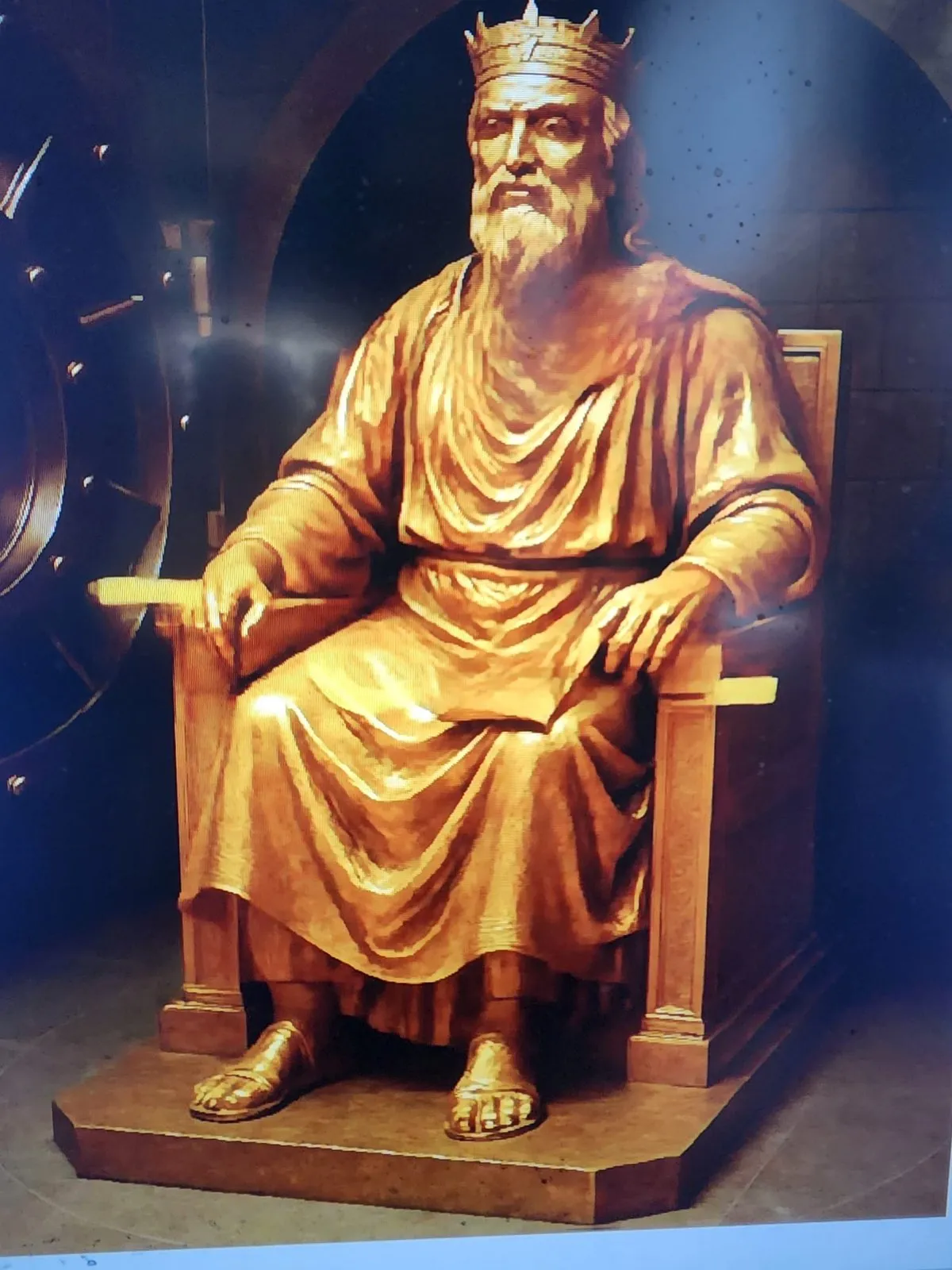
The photos circulating with the listing show two objects: a bust and a seated figure. Both display features common to modern decorative castings:
- a uniform spray-painted gold finish
- visible mold seams
- smooth surfaces with no age, oxidation, or handling wear
- modern lumber for the crate
- current-era packing straps
None of these characteristics match any known ancient metallurgical methods. The claim that this piece is a biblical artifact is unsupported by archaeology or historical record.
The seller asserts that the statue was taken during a Japanese invasion in 1905 and later acquired by the United States Treasury. There is no historical basis for either claim. Japan did not obtain Israelite relics in 1905 or at any time, and the U.S. Treasury has no record of such an item.
Let’s also note that Israel as a state did not exist until 1948, so the claim of an Israeli invasion in 1905 by “Japan” is complete nonsense.
The Documents
The certificates accompanying the statue collapse under basic scrutiny. They include:
“Certificate of Genuineness”
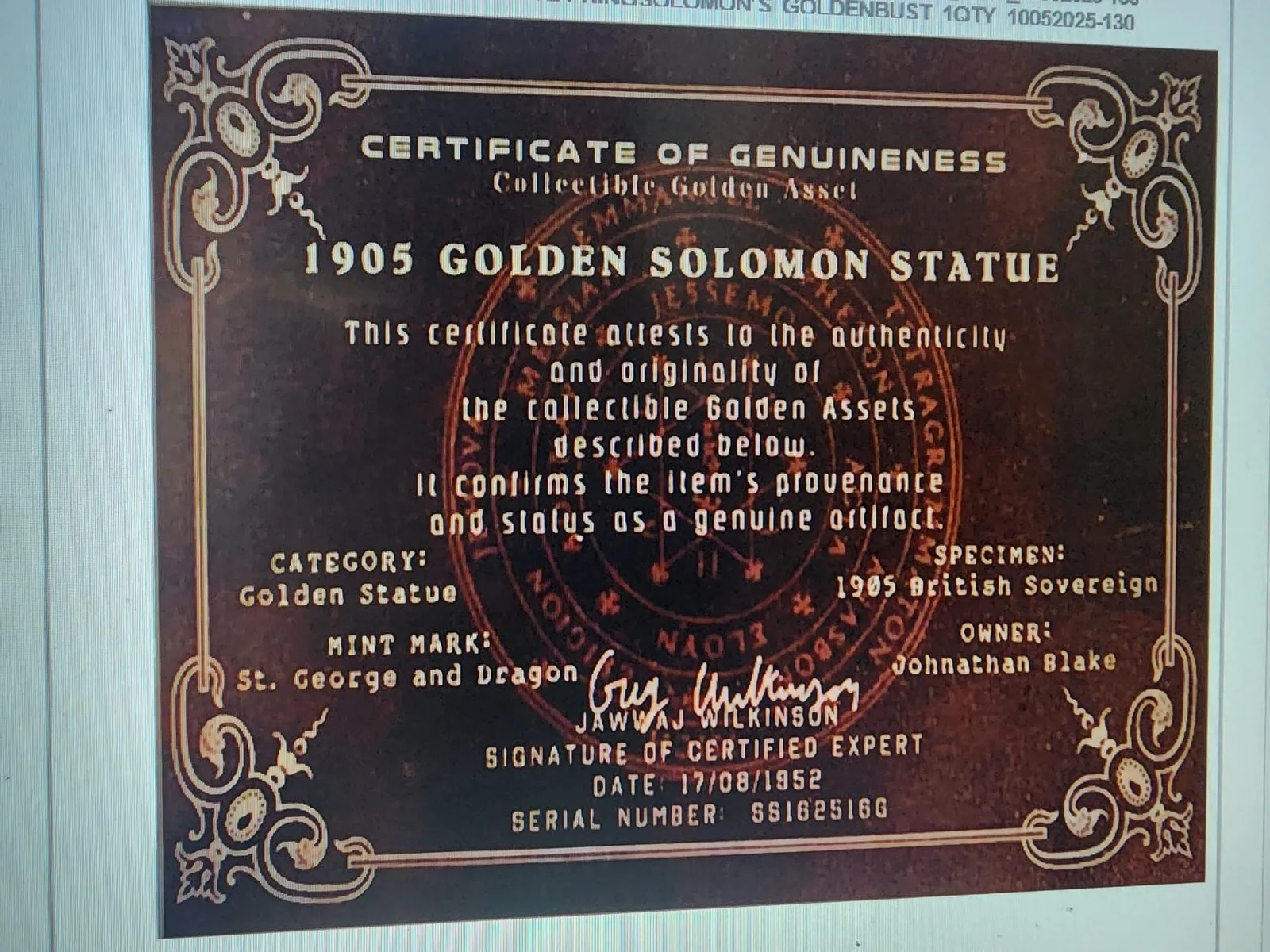
This document misapplies mint marks used for British sovereign coins. A statue is not a coin and cannot have a mint mark. The certificate uses multiple types of fonts, inconsistent spacing, and a forged signature typical of templates found in Southeast Asian scam markets.
Japanese Invasion Golden Statue Document
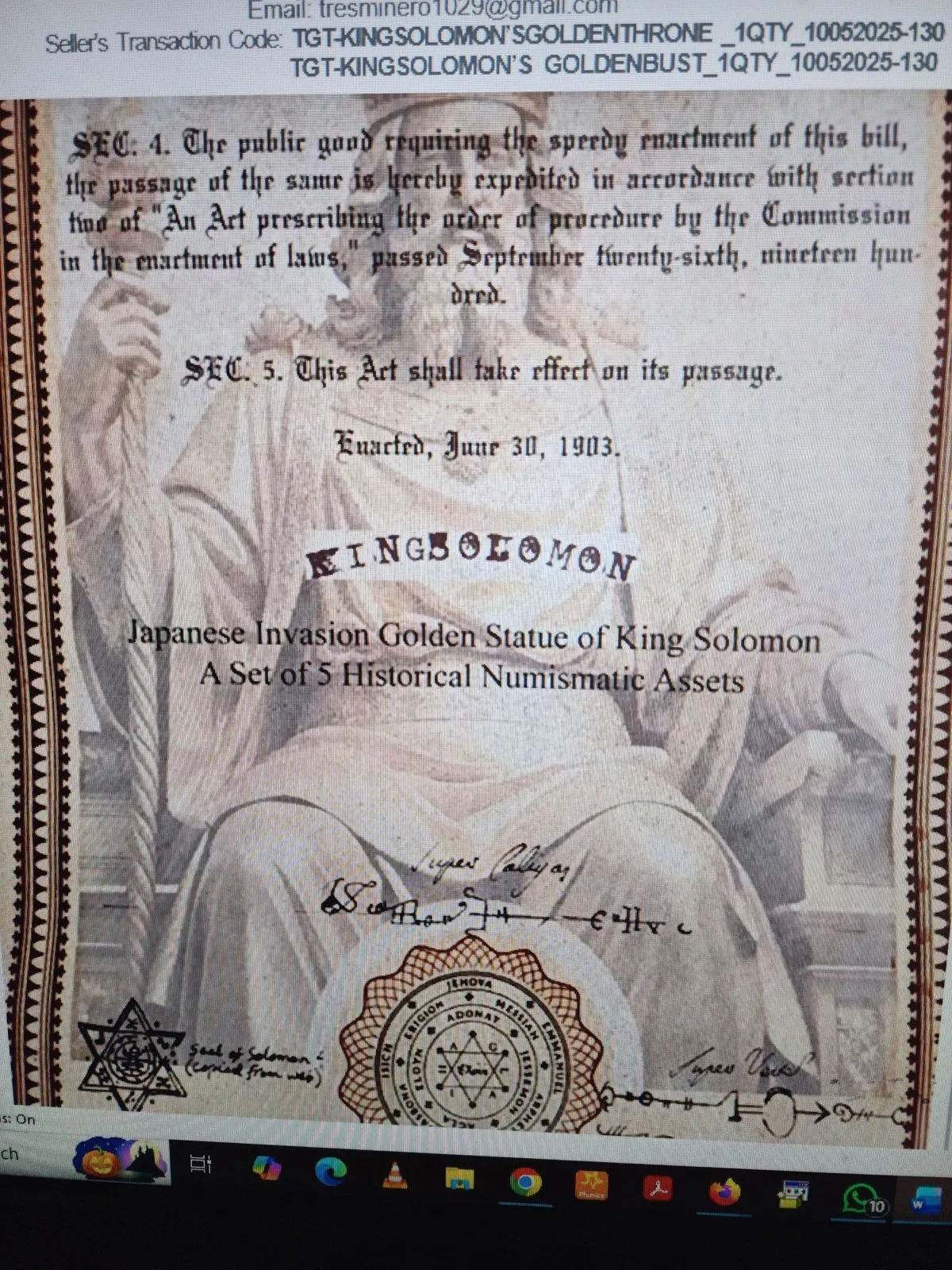
This page includes several spelling errors, distorted lettering, and occult symbols copied from public domain clipart. No issuing authority is identified. No Japanese or U.S. agency has ever produced documentation of this kind.
Bank Certificate (1934)
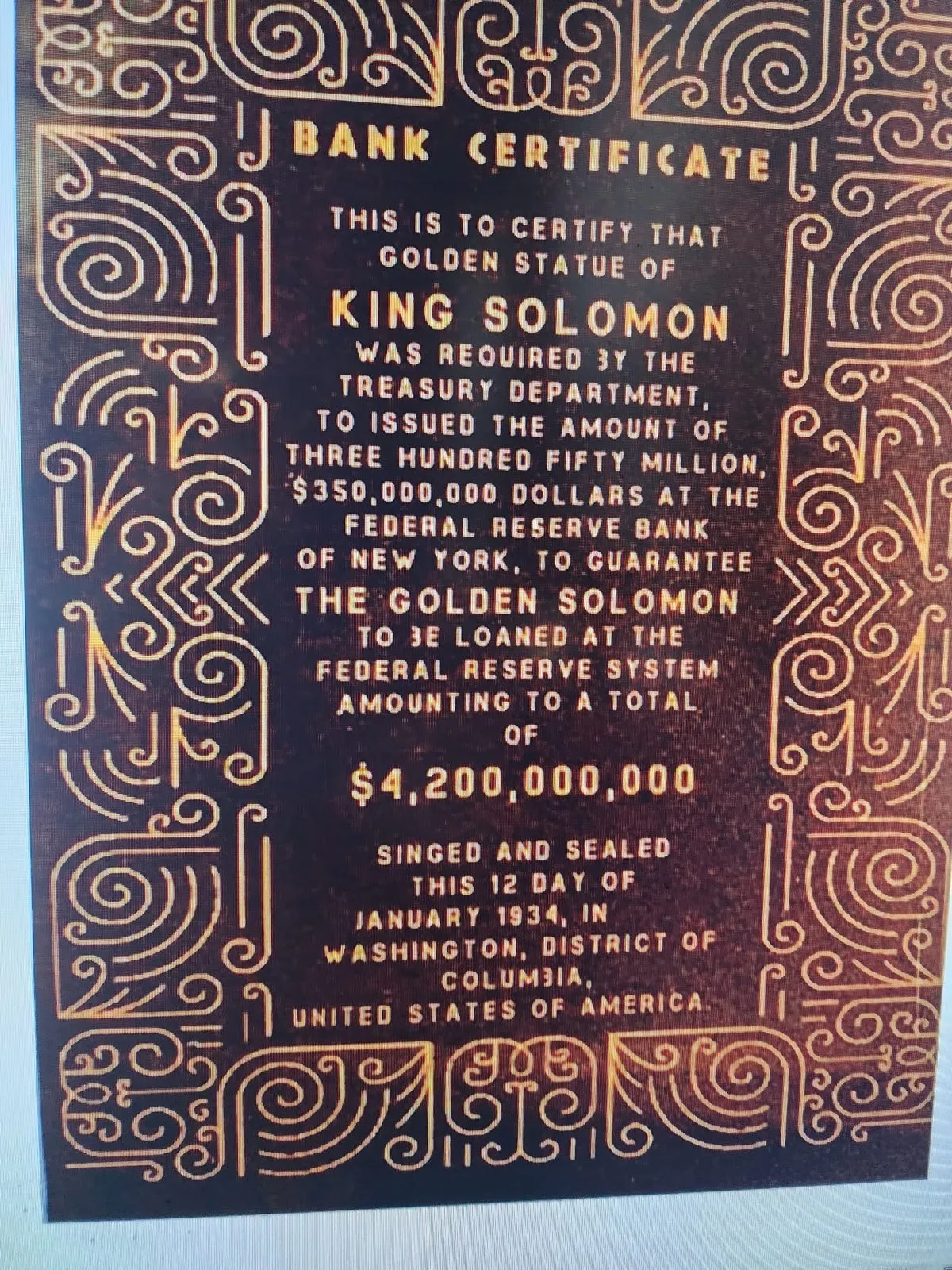
This document claims the Federal Reserve Bank of New York issued 350 million dollars based on the statue, with a total loan valuation of 4.2 billion dollars. This conflicts with historical records in several ways:
- the entire federal budget in 1934 was lower than this claimed amount
- the Federal Reserve does not accept sculptures as collateral
- the grammar is incorrect throughout, such as “singed and sealed”
- formatting is inconsistent with Federal Reserve documents of the time
None of the certificates resemble real government paperwork.
Impossible Financial Claims
The seller states that the statue was required by the Treasury, issued as collateral at the Federal Reserve, and classified as a numismatic asset. Statues are not numismatic items. They cannot receive mint marks or specimen identifiers. There is no legal or financial structure under which a sculpture can act as central bank collateral.
The narrative is completely fabricated.
A Known Fraud Pattern
The structure of this scam mirrors several long-running fraud categories:
- Yamashita treasure
- Golden Buddha scams
- 1934 Federal Reserve bond frauds
- Zimbabwe blue-note boxes
- German 1924 bond scams
- Imperial Japanese treasure certificate frauds
These operations follow a predictable pattern:
- Invent a high value historical object
- Attach counterfeit certificates
- Claim involvement of central banks or governments
- Assign an extreme valuation
- Extract fees for authentication, release, storage, or customs
The statue itself is a prop. The income comes from fees.
Facebook as a Distribution Network
A reverse image search of the statue shows dozens of identical posts across Facebook groups related to gold, diamonds, historical bonds, and bulk currency trading. These groups often operate with tens of thousands of members and function as marketplaces for unverifiable financial instruments.
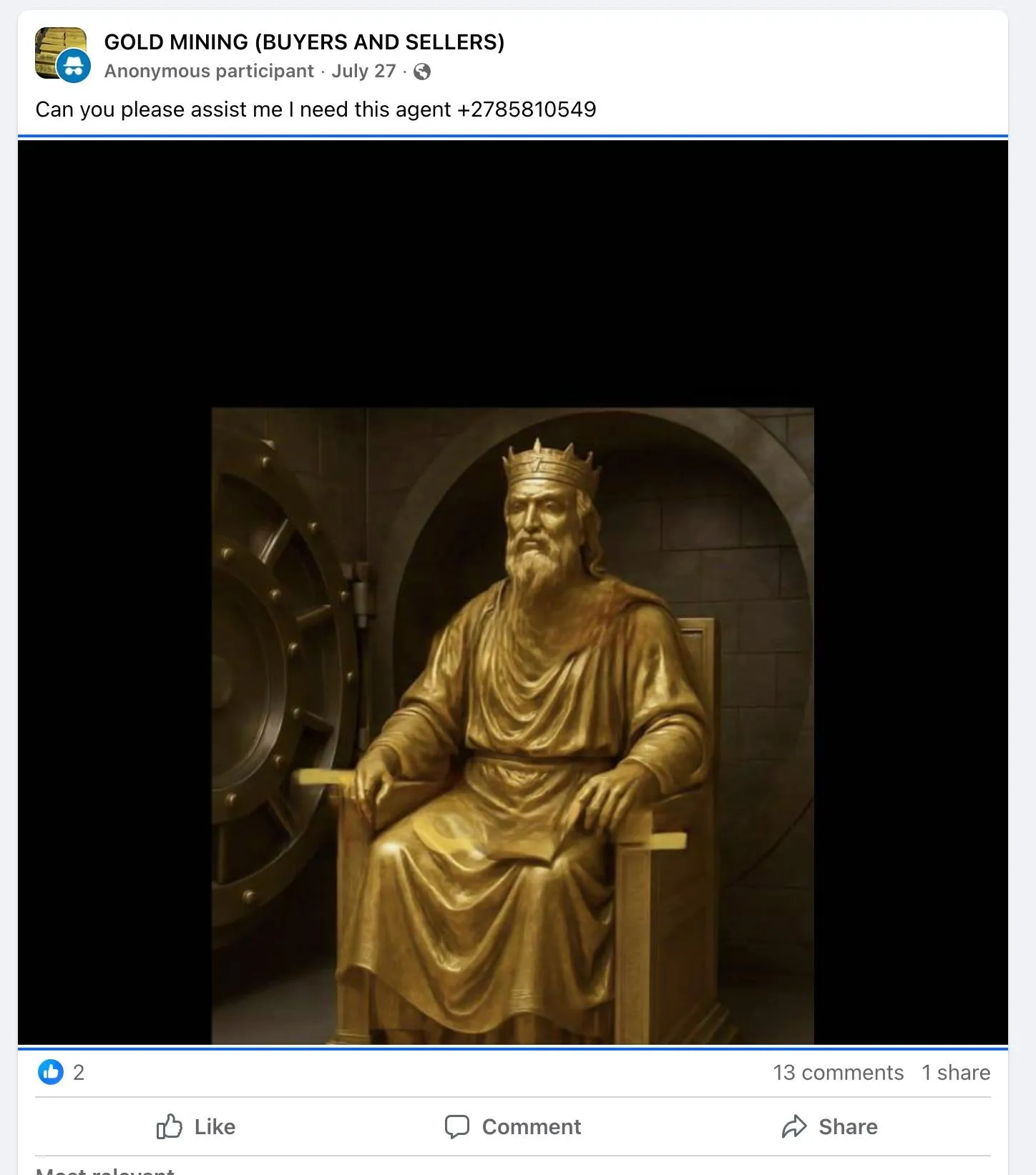
One group, GOLD MINING (BUYERS AND SELLERS), includes multiple posts requesting this statue, all using the same image. The posts ask for agents, buyers, or release partners. The repetition strongly suggests a coordinated network rather than individual sellers.
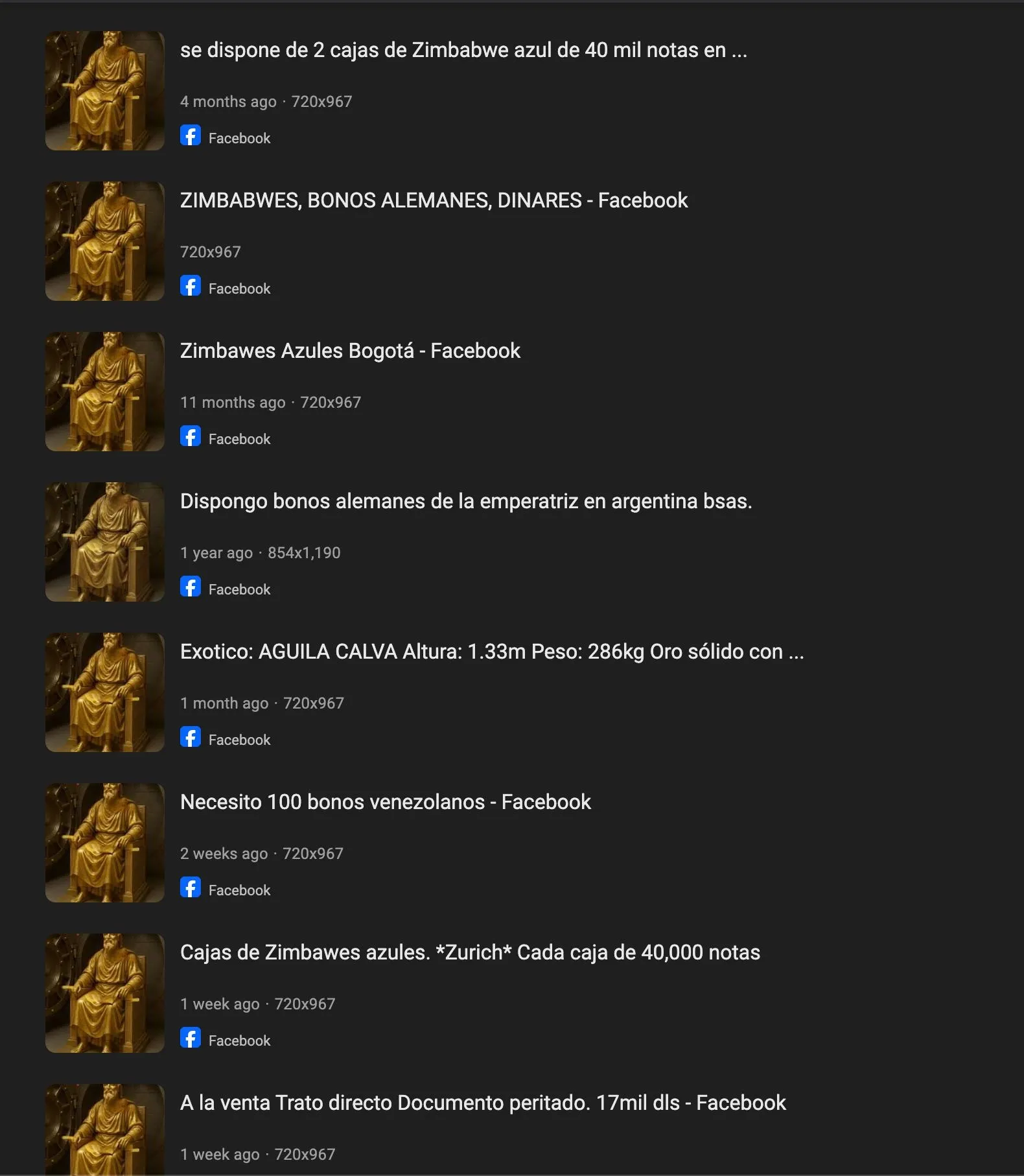
Screenshots show the same statue image used in listings for:
- Zimbabwe blue notes
- German 1924 bonds
- Venezuelan notes
- Dragon bonds
- USD, EUR, Thai baht, and dinar reserves
- sealed boxes of notes supposedly stored in Zurich
These categories are known fraud vectors. Regulators have issued warnings about several of them, including Zimbabwe blue notes and German 1924 bonds.
One group at facebook.com/groups/474645500299693/posts/1400459521051615/ contains the same statue imagery alongside unrelated posts for commercial diamond buyers, gold buyers in Korea, and bulk note traders in Lusaka. None provide verifiable provenance or identification.
The reuse of the statue image across unrelated scams indicates it is a stock fraud asset used to signal high value. Once victims engage, communication typically moves to WhatsApp or Signal, where fee extraction begins.
Conclusion
None of the seller’s claims withstand scrutiny. The statue is modern. The certificates are fabricated. The financial narrative is impossible. The distribution network is tied to a broader ecosystem of historical asset fraud that has circulated for more than a decade.
The listings rely on extraordinary claims presented to audiences with limited access to verification. In the end, the object is not the product. The real commodity is the victim’s willingness to pay fees in pursuit of an asset that does not exist.